.png)


5mins
September 24, 2026
We're Here for a Reason

.jpg)

.svg)
A phone booth looks like a simple purchase: order a box, plug it in, done. In practice, it's one of the easier office investments to get wrong — and one of the most expensive to get wrong twice. Before you commit budget to one, here's what actually matters, and what most spec sheets don't tell you.
Every phone booth manufacturer advertises a decibel reduction figure. The problem: there's no single industry standard for how that number is measured, so a "30 dB" booth from one brand and another can perform very differently in your actual office. Ask for a lab-tested rating (not a marketing estimate), reverberation time inside the booth, and the conditions it was tested under.
One caveat: dB is a logarithmic scale, and a 2–3 dB gap between two "good" booths is often smaller in real use than the price gap between them. It's worth asking whether you're paying for a meaningfully better experience or a slightly better number on paper.
A sealed box with one person, a laptop, and a closed door heats up fast. Poor ventilation is the single biggest source of buyer's remorse — booths get returned or sit unused not because they're too loud, but because they're stuffy after ten minutes.
Look for:
Booths range from single-person "call pods" to multi-person huddle rooms. Before buying:
This is where cheaper booths often cost more in the long run.
The upfront number is rarely the full number. Add up:
A booth advertised at €2,990 and one advertised at €4,500 can end up costing nearly the same once installation and electrical work are added — always ask for an all-in quote before comparing brands.
Depending on your building and location, this can matter more than people expect: fire safety certification for enclosed occupied structures, electrical safety certification (CE, UL, or local equivalent) for outlets and fans, and accessibility compliance if needed. Ask for documentation, not a verbal assurance — but it's also fair to ask whether a given certification is actually required for your building and use case, or a nice-to-have some vendors charge extra for.
Before buying anything, get honest about the actual complaint in your office. It's usually one of these:
A booth solves privacy and containment. It doesn't fix a hall-y, noisy open office on its own — pairing it with acoustic treatment for the rest of the space usually gets better results than a booth alone.


We wrote the checklist above because it's the same list we used when designing our own booth — and we'd rather be upfront about where we land on it than oversell it.
Acoustics: solid. The mute-labs booth is rated at 28.3 dB at 1,000 Hz, 27.9 dB at 2,000 Hz, and 26.1 dB at 4,000 Hz — comfortably enough to hold a confidential call or video meeting without the room hearing you. Some premium booths advertise a few dB more, but dB is a logarithmic scale: for the vast majority of daily use, that difference isn't something most people notice sitting inside the booth or standing outside it. You're paying for acoustics that do the job well, not for chasing the top number on a spec sheet.
Ventilation built into the ceiling, not bolted on. The fan is integrated into the ceiling module and moves 100 m³/h, giving a full air exchange roughly every 60 seconds — enough for back-to-back calls without a stuffy booth by hour two.
Fast, self-assembly setup. No specialized crew required — the booth self-assembles in 45–60 minutes. Minimum ceiling height is 2.40 m, with 20 cm clearance around the unit and 15 cm overhead in use, so you can check fit before it arrives. Delivery takes 2–4 weeks, and every booth comes with a 2-year warranty plus a 100-day free trial. Assembly cost is quoted separately alongside delivery.
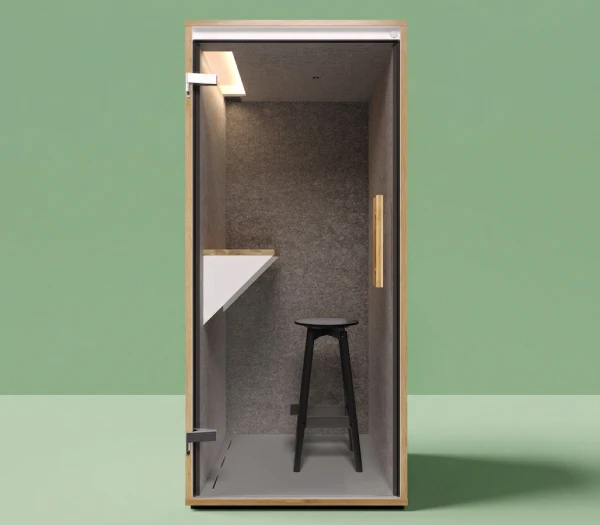
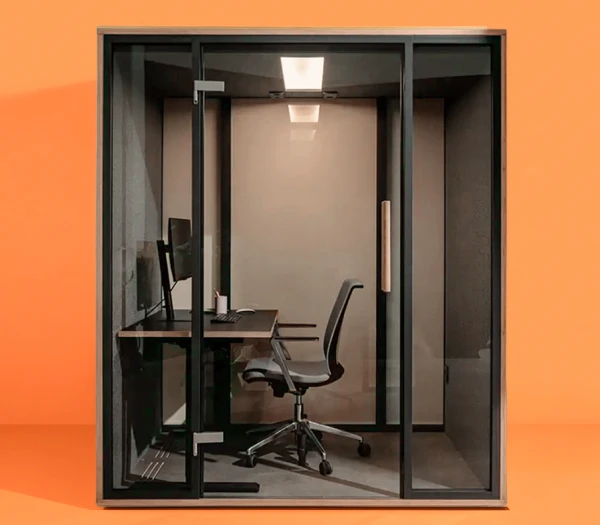
Materials chosen for daily use. Exterior panels are white melamine-coated particleboard with bamboo veneer; the door handle and desk are solid oak; interior lining is grey felt made from recycled PET; the door is toughened safety glass (ESG).
The pitch: if what you need is real privacy for calls and confidential conversations — not the highest number on a spec sheet — the mute-labs booth gets you there without paying a premium for marginal improvements most people won't notice day to day.
.svg)
.svg)

A phone booth looks like a simple purchase: order a box, plug it in, done. In practice, it's one of the easier office investments to get wrong — and one of the most expensive to get wrong twice. Before you commit budget to one, here's what actually matters, and what most spec sheets don't tell you.
Every phone booth manufacturer advertises a decibel reduction figure. The problem: there's no single industry standard for how that number is measured, so a "30 dB" booth from one brand and another can perform very differently in your actual office. Ask for a lab-tested rating (not a marketing estimate), reverberation time inside the booth, and the conditions it was tested under.
One caveat: dB is a logarithmic scale, and a 2–3 dB gap between two "good" booths is often smaller in real use than the price gap between them. It's worth asking whether you're paying for a meaningfully better experience or a slightly better number on paper.
A sealed box with one person, a laptop, and a closed door heats up fast. Poor ventilation is the single biggest source of buyer's remorse — booths get returned or sit unused not because they're too loud, but because they're stuffy after ten minutes.
Look for:
Booths range from single-person "call pods" to multi-person huddle rooms. Before buying:
This is where cheaper booths often cost more in the long run.
The upfront number is rarely the full number. Add up:
A booth advertised at €2,990 and one advertised at €4,500 can end up costing nearly the same once installation and electrical work are added — always ask for an all-in quote before comparing brands.
Depending on your building and location, this can matter more than people expect: fire safety certification for enclosed occupied structures, electrical safety certification (CE, UL, or local equivalent) for outlets and fans, and accessibility compliance if needed. Ask for documentation, not a verbal assurance — but it's also fair to ask whether a given certification is actually required for your building and use case, or a nice-to-have some vendors charge extra for.
Before buying anything, get honest about the actual complaint in your office. It's usually one of these:
A booth solves privacy and containment. It doesn't fix a hall-y, noisy open office on its own — pairing it with acoustic treatment for the rest of the space usually gets better results than a booth alone.
We wrote the checklist above because it's the same list we used when designing our own booth — and we'd rather be upfront about where we land on it than oversell it.
Acoustics: solid. The mute-labs booth is rated at 28.3 dB at 1,000 Hz, 27.9 dB at 2,000 Hz, and 26.1 dB at 4,000 Hz — comfortably enough to hold a confidential call or video meeting without the room hearing you. Some premium booths advertise a few dB more, but dB is a logarithmic scale: for the vast majority of daily use, that difference isn't something most people notice sitting inside the booth or standing outside it. You're paying for acoustics that do the job well, not for chasing the top number on a spec sheet.
Ventilation built into the ceiling, not bolted on. The fan is integrated into the ceiling module and moves 100 m³/h, giving a full air exchange roughly every 60 seconds — enough for back-to-back calls without a stuffy booth by hour two.
Fast, self-assembly setup. No specialized crew required — the booth self-assembles in 45–60 minutes. Minimum ceiling height is 2.40 m, with 20 cm clearance around the unit and 15 cm overhead in use, so you can check fit before it arrives. Delivery takes 2–4 weeks, and every booth comes with a 2-year warranty plus a 100-day free trial. Assembly cost is quoted separately alongside delivery.
Materials chosen for daily use. Exterior panels are white melamine-coated particleboard with bamboo veneer; the door handle and desk are solid oak; interior lining is grey felt made from recycled PET; the door is toughened safety glass (ESG).
The pitch: if what you need is real privacy for calls and confidential conversations — not the highest number on a spec sheet — the mute-labs booth gets you there without paying a premium for marginal improvements most people won't notice day to day.
.svg)
.svg)
.svg)